Author: Site Editor Publish Time: 2026-08-11 Origin: Site
Industrial component failure from wear, erosion, and corrosion forces heavy operational downtime and replacement expenses. Surface modification fixes this, but it requires precise engineering decisions. Plant managers and reliability engineers must balance extreme surface durability against substrate distortion risks, application logistics, and complex part geometries. Picking the wrong hardfacing method guarantees premature coating delamination or destroys the base metal integrity.
We evaluate thermal spray and laser cladding technologies based on process mechanics, field performance, and material compatibility. Understanding heat input, bonding mechanisms, and specific material behaviors ensures you match the right process to your exact wear environment. This prevents catastrophic equipment failure and extends the operational lifespan of critical infrastructure.
Bonding Mechanisms Dictate Application: Laser cladding utilizes a metallurgical bond ideal for high-impact environments, whereas thermal spray relies on a mechanical bond, offering lower heat input and broader substrate compatibility.
Thermal Management is Critical: While laser cladding offers a highly localized heat-affected zone (HAZ), advanced thermal spray methods like HVOF provide exceptionally dense coatings with minimal risk of bulk substrate distortion.
Scalability and Part Size Influence Selection: Thermal spray excels in rapid, large-scale coverage and thick deposits for massive components, whereas laser cladding is optimized for precision deposition on specific, high-wear localized areas.
Cost Structures Differ Significantly: Thermal spray generally presents lower upfront equipment and application costs but may incur higher masking and overspray expenses. Laser cladding requires higher initial capital but offers superior material efficiency and longer lifecycle performance in severe wear applications.
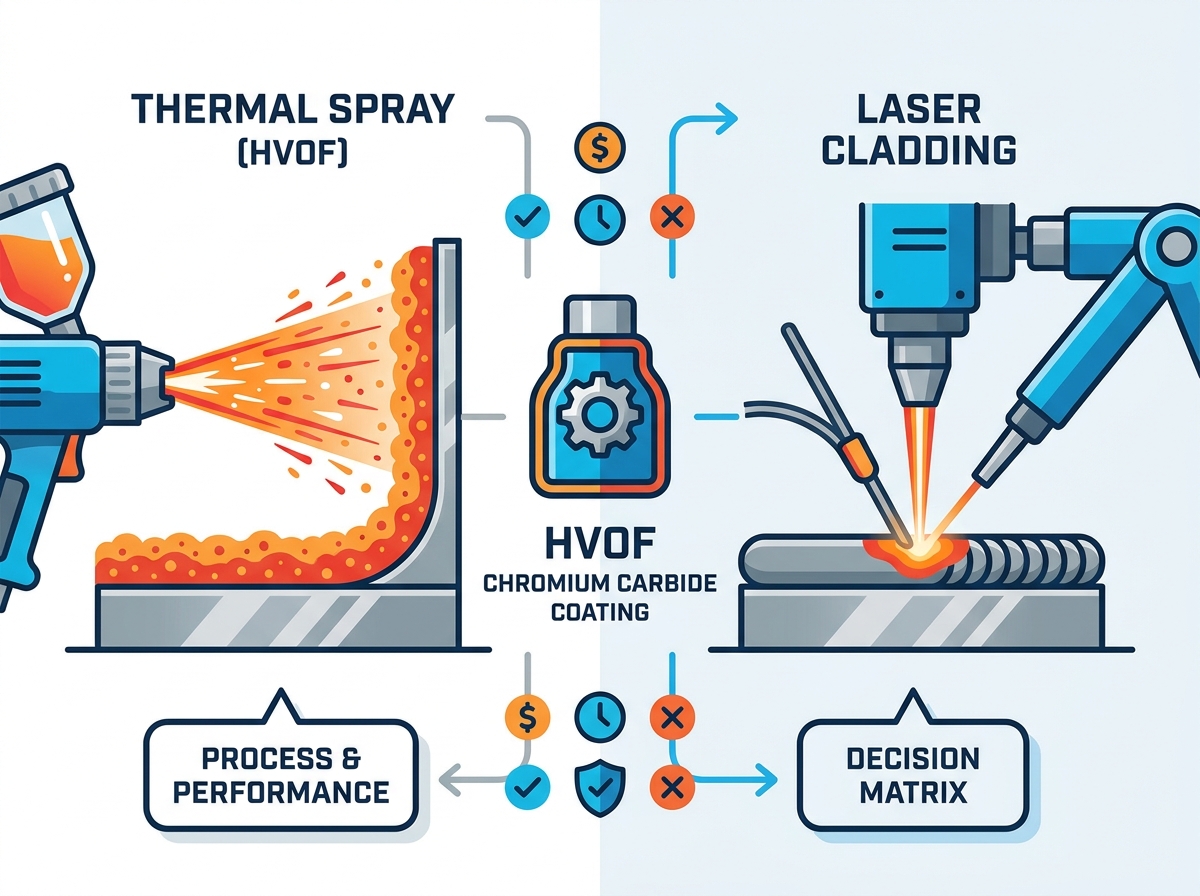
Material Specificity Matters: The choice between processes often comes down to the required coating material; for instance, HVOF chromium carbide coating remains a benchmark for sliding wear and high-temperature erosion resistance where metallurgical mixing is undesirable.
Table of Contents
Engineers must understand how energy sources and material deposition methods alter the final coating structure and the base material. The physical mechanics of material transfer dictate the performance limits of the finished component on the shop floor.
Thermal spray accelerates semi-molten or fully molten particles toward a prepared substrate. The system uses a heat source to melt the feedstock, which process gases then propel forward. Upon impact, these particles flatten into splats. They rapidly cool and mechanically interlock with the roughened surface and previously deposited layers. This mechanical bond relies heavily on kinetic energy rather than deep substrate melting.
To understand splat formation, consider the sequence of deposition:
Particle heating and acceleration within the combustion or electrical plume.
Impact and rapid plastic deformation against the abrasive-blasted substrate profile.
Instantaneous cooling, causing microscopic shrinkage and mechanical gripping.
Successive particle impacts building the coating thickness layer by layer.
Variations exist to handle different materials and operational demands. Flame spray and arc spray deliver high deposition rates for dimensional restoration on large shafts. Plasma spray generates extreme temperatures for ceramic thermal barrier coatings used in aerospace. High-Velocity Oxygen Fuel (HVOF) uses supersonic gas velocities, often fueled by kerosene or hydrogen, to produce highly dense, strongly adhered metallic and carbide coatings. Cold spray uses kinetic energy alone to deform solid-state particles without melting, ideal for heat-sensitive materials where oxidation is unacceptable.
The spray and fuse method acts as a hybrid. Operators apply a thermally sprayed coating—usually a nickel or cobalt self-fluxing alloy—and melt it using a torch or induction coil. This secondary heating transforms the mechanical bond into a metallurgical bond. However, it introduces massive bulk heat into the component, increasing distortion risks.
Laser cladding uses a focused laser beam, typically from a high-power diode or fiber laser, to create a shallow, precise melt pool on the substrate surface. A nozzle introduces feedstock material in powder or wire form directly into this melt pool. As the laser moves along the component, the trailing edge of the melt pool rapidly solidifies, leaving a fully dense overlay.
This process forms a true metallurgical bond. The applied material fuses directly with the base metal at a molecular level. Advanced laser optics and parameter control allow operators to minimize dilution—the mixing of the base metal into the coating layer. Keeping dilution low ensures the cladding retains its intended chemical composition and wear properties right from the first pass.
The focused laser beam provides distinct advantages for complex geometries. Operators deposit material exactly where needed, such as on the leading edge of a turbine blade or the sealing face of a valve, without affecting adjacent areas. This localized control reduces extensive post-weld machining and preserves the mechanical properties of the surrounding base metal.
Comparing the physical and mechanical properties of the applied coatings determines their suitability for specific wear and corrosion environments. We evaluate how these processes perform under actual operational stress.
Bond strength dictates how well a coating resists spalling under load. Thermal spray relies on mechanical adhesion. Testing, such as the ASTM C633 standard, measures this strength in megapascals (MPa). While advanced methods achieve high mechanical bond strengths exceeding 80 MPa, these coatings remain susceptible to spalling under severe point-loading or high-impact conditions. The mechanical interlocking fails if the softer substrate deforms beneath the rigid coating.
Laser cladding produces a metallurgical fusion bond. The bond strength equals or exceeds the strength of the base material itself. This makes laser-clad overlays highly resistant to impact and heavy mechanical stress. The coating becomes an integral part of the substrate structure and will not delaminate even under extreme mechanical shock.
Standard thermal spray processes inherently produce porosity, typically ranging from 1% to 5%. As particles impact and cool, microscopic voids form between the splats. In corrosive environments, these interconnected pores allow aggressive media to penetrate the coating and attack the substrate. Engineers specify polymer or epoxy sealers to close this porosity and prevent galvanic corrosion.
Laser-clad overlays are fully dense with zero porosity. The complete melting and solidification process eliminates voids, creating an impermeable barrier. This makes laser cladding highly effective for severe corrosion applications without secondary sealing steps.
Advanced thermal spray processes bridge this gap. HVOF systems utilize extreme kinetic energy to compact particles upon impact, achieving porosity levels well below 1%. This near-theoretical density provides excellent corrosion resistance comparable to clad overlays in many environments.
Property | Thermal Spray (Standard) | Thermal Spray (HVOF) | Laser Cladding |
|---|---|---|---|
Bond Type | Mechanical Interlocking | Mechanical (High Adhesion) | Metallurgical Fusion |
Porosity Level | 1% - 5% | < 1% | 0% (Fully Dense) |
Heat Input to Substrate | Low (Bulk heating) | Low to Moderate | High (Localized HAZ) |
Impact Resistance | Low | Moderate | High |
Typical Thickness Limit | High (Multi-pass capable) | Moderate (Stress limited) | Moderate (Crack sensitive) |
Managing heat input maintains the dimensional stability and metallurgical integrity of the base component. Laser cladding produces a highly localized heat-affected zone (HAZ). While peak temperatures in the melt pool are extreme, the rapid travel speed and focused energy limit the total heat absorbed by the bulk component. However, this localized thermal cycling induces residual stresses and potential martensitic transformations requiring post-weld heat treatment.
Thermal spray transfers significantly less overall heat to the substrate. Particles cool rapidly upon impact. Operators use compressed air or carbon dioxide cooling jets to maintain low bulk component temperatures during application. This makes thermal spray preferable for temperature-sensitive substrates, heat-treated alloys, or thin-walled components prone to warping under thermal stress.
When restoring worn components, volumetric coverage rates matter. Thermal spray, particularly wire arc and flame spray, rapidly builds thick deposits over large surface areas. Operators restore significant dimensional losses quickly, making it efficient for massive industrial rolls or large hydraulic cylinders.
Laser cladding offers precise, controllable layer thicknesses, usually ranging from 0.5mm to 2mm per pass. While it builds thick layers through multiple passes, the process is slower than thermal spray for massive volumetric build-ups. Laser cladding works best when applying specific, high-performance alloys to localized wear zones rather than coating entire large-scale surfaces.
Examining a specific industrial wear solution illustrates the practical trade-offs between these two surface engineering methods. Carbide-based coatings provide exceptional wear resistance, but the application method drastically alters their performance in the field.
The industry standard for applying chromium carbide (Cr3C2-NiCr) is the High-Velocity Oxygen Fuel process. Chromium carbide provides excellent resistance to sliding wear, fretting, and high-temperature erosion up to 850°C. The success of this material depends entirely on preserving the hard carbide particles within the softer nickel-chromium matrix during application.
HVOF achieves this preservation through its unique balance of high kinetic energy and lower thermal energy. The process heats the powder just enough to soften the binder matrix while propelling it at supersonic speeds. This prevents the degradation, or decarburization, of the carbide particles. If the carbides overheat, they dissolve into the matrix, forming brittle phases that ruin the coating's wear properties. When engineers need to protect boiler tubes, compressor blades, or hydraulic rods, specifying an HVOF chromium carbide coating ensures maximum sliding wear resistance without altering the base metal metallurgy.
Primary use cases involve environments demanding extreme erosion resistance. The dense, mechanically bonded structure handles continuous abrasive flow and high-temperature oxidation exceptionally well, making it a staple in power generation and petrochemical refining.
Applying tungsten or chromium carbides via laser cladding presents different challenges and benefits. Laser cladding creates a metal matrix composite (MMC), typically using a nickel or cobalt alloy matrix infused with hard carbide particles. This creates a metallurgically bonded overlay capable of withstanding severe impact alongside abrasive wear.
The primary risk during laser cladding is carbide dissolution. The extreme temperatures of the laser melt pool melt the carbide particles, causing them to dissolve into the surrounding matrix. This alters the matrix properties, making it brittle, and reduces the overall volume fraction of hard particles available for wear resistance. Operators strictly control laser power, travel speed, and powder feed rates to minimize heat input and preserve the carbides.
When controlled correctly, laser-clad carbides offer superior impact resistance compared to the HVOF alternative. The metallurgical bond prevents spalling under heavy mechanical shocks. However, the maximum achievable coating thickness for crack-free carbide claddings is often limited due to differing thermal expansion coefficients between the hard overlay and the softer substrate.
Evaluating surface modification requires looking beyond per-hour application rates. Engineers calculate the overall operational value, factoring in equipment capital, material efficiency, and long-term maintenance intervals.
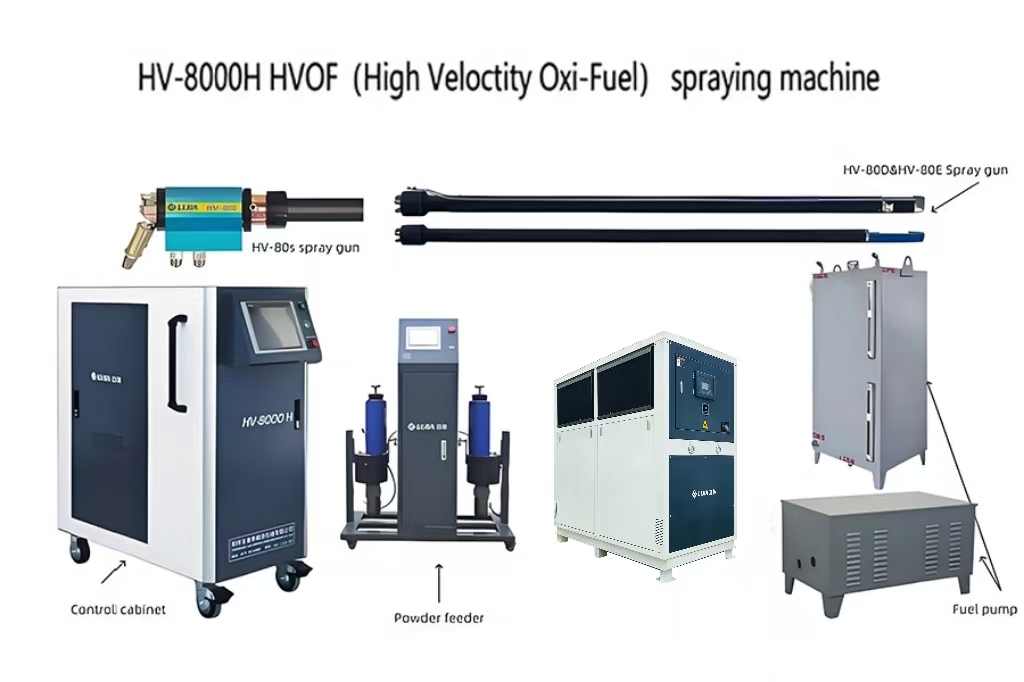
Laser cladding systems require high initial equipment and setup costs. The laser source, precision robotics, powder feeders, and safety enclosures represent a massive capital expenditure. This high barrier to entry reflects in the application costs charged by service providers. Thermal spray infrastructure is more accessible. While advanced HVOF consoles require investment, the overall system footprint and capital requirements are lower than high-powered laser setups.
Part size directly impacts the cost-effectiveness of each process. Thermal spray scales efficiently for massive industrial components. Coating a large paper mill roll or a massive hydraulic ram is highly cost-effective using thermal spray due to its high deposition rates. Conversely, laser cladding costs escalate rapidly on large surface areas. Unless utilizing advanced high-speed laser optics, the slower coverage rate of standard laser cladding makes it less economical for massive, full-surface applications.
Cost Factor | Thermal Spray | Laser Cladding |
|---|---|---|
Initial Equipment Capital | Moderate | Very High |
Deposition Rate (Large Areas) | Fast (Highly Economical) | Slow (Less Economical) |
Masking Requirements | Extensive (High Labor) | Minimal (Low Labor) |
Powder Catch Efficiency | Low to Moderate (High Overspray) | High (Minimal Waste) |
Hidden costs significantly influence the final project value. Thermal spray requires extensive masking. Because the spray plume is relatively wide, operators protect adjacent surfaces, threads, and internal bores from unwanted coating deposition. Masking materials and the labor required to apply and remove them add to operational expenses. Additionally, thermal spray has lower deposition efficiency. A significant percentage of the sprayed powder bounces off the part or misses it entirely, resulting in higher overspray waste.
Laser cladding offers high powder catch efficiency. The focused nature of the laser and the precise powder delivery system ensure that most of the feedstock enters the melt pool. This precise deposition minimizes overspray and drastically reduces masking requirements. The ability to apply material near net shape also minimizes post-process machining labor, offsetting some of the higher initial application costs.
Calculating return on investment requires analyzing the mean time between failures (MTBF). The higher upfront cost of laser cladding pays off when the component operates in a severe impact or high-stress environment where a mechanically bonded coating fails prematurely. Extending the operational life of a critical mining excavator component by several months justifies the initial cladding expense by reducing costly downtime.
Thermal spray remains the more cost-effective choice for rapid, large-area dimensional restoration or scheduled maintenance turnarounds. When a component experiences predictable, uniform sliding wear, a thermally sprayed coating provides excellent life extension at a fraction of the cladding cost. Fast turnaround times keep industrial facilities running efficiently during planned outages.
Adopting either technology on the shop floor or in the field introduces practical challenges. Engineers address accessibility, safety compliance, and quality assurance to ensure successful implementation.
Both processes suffer from line-of-sight limitations. The spray nozzle or laser head must have direct access to the surface being coated. Coating internal diameters (IDs) is notoriously difficult. Thermal spray requires specialized ID extension torches, and the coating quality degrades as the bore diameter decreases. Laser cladding offers specialized ID optics, but these are expensive and have strict depth limitations.
Robotic integration is mandatory for laser cladding to maintain precise focal lengths and travel speeds on complex 3D geometries. This requires sophisticated programming and part manipulation. Thermal spray, while often roboticized for consistency, retains the flexibility for manual or semi-automated application for certain repairs. Positioning massive parts for precision laser cladding requires heavy-duty, high-precision handling equipment. Thermal spray equipment is more mobile, allowing for on-site field repairs of large infrastructure.
Environmental sensitivity differs vastly between the processes. Thermal spray, especially HVOF, generates extreme noise levels, intense ultraviolet light, and significant volumes of fine metallic dust. Facilities require robust acoustic enclosures, heavy-duty dust extraction systems, and strict respiratory protection for operators to maintain EHS compliance.
Laser cladding requires strict adherence to laser safety protocols. Class 4 lasers necessitate light-tight safety enclosures with interlocked doors to prevent accidental exposure to scattered radiation. While laser cladding generates less airborne dust than thermal spray, handling fine metallic powders still requires proper ventilation and respiratory protection to mitigate inhalation risks and prevent combustible dust hazards.
Verifying coating integrity requires different testing protocols based on the bonding mechanism. For thermal spray, acceptance criteria focus on measuring porosity, oxide content, and mechanical bond strength. Operators use microstructural cross-sectioning on test coupons sprayed concurrently with the actual part to verify these parameters. Ultrasonic testing sometimes detects severe delamination, but it struggles with the inherent layered structure of the spray.
Laser cladding requires NDT methods suited for welded structures. Dye penetrant testing effectively identifies surface cracks or porosity in the overlay. Ultrasonic testing is highly effective at verifying the metallurgical bond line and detecting lack of fusion or subsurface defects. Acceptance criteria for laser cladding are stricter regarding cracks and porosity, reflecting its use in high-stress applications.
Conduct a localized wear analysis on failed components to determine if the primary degradation mechanism is high-impact force, sliding friction, or chemical corrosion.
Specify laser cladding for structural repairs on components subjected to heavy point-loading that require a true metallurgical bond and zero porosity.
Specify thermal spray for large surface areas, temperature-sensitive substrates, and environments demanding extreme erosion resistance without altering the base metal metallurgy.
Request material test coupons from vendors to evaluate porosity, bond strength, and microstructural integrity before finalizing the engineering specification.
A: Thermal spray relies on mechanical interlocking, achieving bond strengths between 30 and 80 MPa. It remains susceptible to spalling under high point-loading. Laser cladding creates a metallurgical fusion bond. The bond strength equals or exceeds the base material, making it highly resistant to impact and delamination.
A: Specify this coating for large-scale coverage needs involving severe sliding wear and high-temperature erosion. It works best when you must avoid bulk substrate heating and prevent hard carbide particles from dissolving into a melt pool, which frequently occurs during high-heat laser cladding.
A: Laser cladding produces a highly localized heat-affected zone with extreme peak temperatures, inducing residual stress. Thermal spray transfers less overall bulk heat to the substrate, significantly reducing the risk of warping. For ultra-low heat requirements, cold spray offers a solid-state alternative with zero melting.
A: Both face strict line-of-sight limitations. Thermal spray uses extension torches but struggles with small bores. Laser cladding uses specialized optics for precise internal coating. However, these tools are expensive and heavily limited by the depth and diameter of the bore.
A: Thermal spray requires more post-machining. It produces a wider spray plume, has lower deposition efficiency, and requires extensive masking. Laser cladding deposits material precisely near net shape. This minimizes overspray and significantly reduces the labor needed for final dimensional machining.