Author: Site Editor Publish Time: 2026-08-11 Origin: Site
In high-performance surface engineering, choosing between thermal melting and kinetic consolidation determines component lifespan and structural integrity. Selecting the wrong coating technology causes unacceptable heat-affected zones (HAZ), substrate distortion, premature delamination, or the physical inability to coat complex geometries. These engineering failures lead to severe part degradation, catastrophic system faults, and extended maintenance downtime across heavy industrial operations. You must evaluate bonding mechanisms, feedstock particle sizes, material compatibility, and geometric constraints to match the right surface modification process to your specific mechanical demands. This evaluation becomes especially critical when addressing complex line-of-sight challenges like HVOF internal diameter coating. We rely on strict technical parameters, metallurgical analysis, and proven field data rather than guesswork to ensure long-term operational reliability. Proper application prevents premature wear and maintains tight dimensional tolerances under extreme stress.
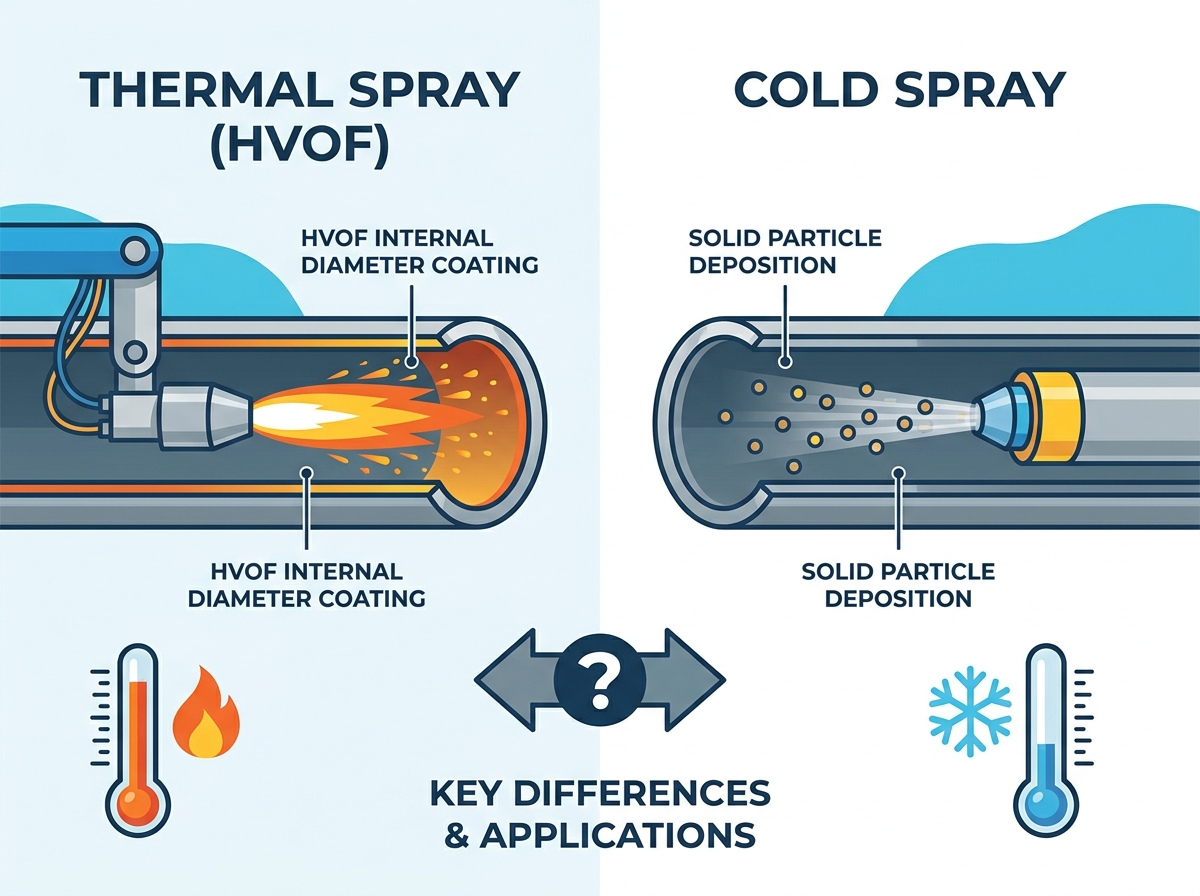
Mechanism & Particle Distinction: Thermal spray relies on high temperatures to melt or semi-melt larger particles for deposition, whereas cold spray utilizes supersonic kinetic energy to plastically deform much smaller solid particles, eliminating oxidation and thermal stress.
Material Suitability: Cold spray is optimal for oxygen-sensitive metals, dissimilar metal bonding, and temperature-sensitive substrates (e.g., titanium, aluminum, copper), while thermal spray excels with hardmetals, ceramics, and high-temperature alloys.
Geometric Feasibility: Line-of-sight constraints heavily influence technology selection; specialized HVOF internal diameter coating systems offer proven solutions for internal geometries where cold spray nozzles cannot physically operate.
Application Focus: Thermal spray remains the industry standard for wear and corrosion resistance at scale, whereas cold spray dominates aerospace structural repair, dimensional restoration, and additive manufacturing due to minimized material degradation.
Table of Contents
Thermal spray systems use a concentrated heat source to melt or semi-melt powder or wire feedstock. The heat source comes from chemical combustion or an electrical arc. Once the feedstock reaches a molten state, high-pressure process gases accelerate the droplets toward the target substrate. During the impact phase, these molten droplets strike the surface at high velocities. They flatten out into distinct disc-like shapes called splats. These splats rapidly cool and solidify, building up layer by layer to form a lamellar structure. This overlapping microstructure provides the mechanical barrier against wear and corrosion.
Common variants include:
High-Velocity Oxygen Fuel (HVOF)
Atmospheric Plasma Spray (APS)
Twin Wire Arc Spray
Conventional Flame Spray
Thermal spray feedstock uses larger particle sizes compared to cold spray powders. Larger particles improve powder flowability through feeder lines. However, they require significantly higher thermal energy to reach the necessary molten state before impact. For instance, Atmospheric Plasma Spray generates plume temperatures exceeding 10,000°C, easily melting refractory ceramics. HVOF operates at lower temperatures but compensates with supersonic gas velocities, producing denser coatings. The splat cooling rate often exceeds one million degrees per second. This rapid quenching locks in specific metallurgical phases, though it can introduce tensile residual stresses if not managed with proper external cooling jets.
Cold spray technology operates on a fundamentally different physical principle. It relies entirely on kinetic energy rather than thermal energy. The process accelerates solid metal powders through a converging-diverging de Laval nozzle using heated, high-pressure carrier gases like nitrogen or helium. The bonding mechanism occurs entirely in the solid state. Particles impact the substrate at supersonic velocities ranging from Mach 1 to Mach 4. Upon impact, the particles undergo severe plastic deformation. This kinetic energy transforms into localized strain, causing adiabatic shear instability at the particle-substrate interface. The result is intense mechanical interlocking and metallurgical bonding without the material ever reaching its melting point.
Cold spray systems fall into two operational categories:
High-Pressure Cold Spray (HPCS): Injects powder upstream of the nozzle throat. This achieves maximum particle velocity, making it suitable for dense, structural buildups and spraying harder metals like titanium or steel alloys.
Low-Pressure Cold Spray (LPCS): Uses a low-pressure powder feeder to introduce particles downstream of the nozzle throat. This variant is highly portable and ideal for lighter repairs or depositing softer, highly ductile metals like zinc or copper.
Remaining strictly in the solid state prevents in-flight oxidation. It eliminates the tensile residual stresses and undesirable metallurgical transformations associated with high-heat processes. Operators must carefully monitor the critical velocity of the specific powder being sprayed. If particles strike the substrate below this critical velocity threshold, they simply bounce off, causing severe nozzle clogging and wasting expensive feedstock.
Evaluating thermal spray requires understanding the risks of high process temperatures. The intense heat transferred to the underlying substrate can alter its original temper. In thin-walled components, this thermal input causes severe warping or dimensional distortion. Localized heating degrades the base material's fatigue life, creating a heat-affected zone (HAZ) that weakens the overall structural integrity of the part. For example, aerospace aluminum alloys like 7075-T6 lose their precipitation-hardened temper when exposed to temperatures above 150°C.
Cold spray offers distinct advantages for thermal management. The process imparts compressive residual stresses into the substrate rather than tensile stresses. Combined with exceptionally low bulk heat input, cold spray entirely eliminates the formation of a HAZ. This minimized material degradation preserves the original mechanical properties, temper, and fatigue resistance of the underlying component. You can safely repair heat-sensitive alloys without requiring post-weld heat treatment.
Microstructural analysis reveals significant differences between the two technologies. Thermal spray coatings typically exhibit porosity levels ranging from 1% to 5%, depending on the specific process variant. Because particles travel through the atmosphere in a molten state, they frequently absorb oxygen. This leads to varying levels of oxide inclusions within the final coating structure. Interconnected porosity can allow corrosive media to penetrate down to the base metal, requiring secondary polymer sealers.
Cold spray contrasts sharply with these traditional microstructures. The use of ultra-fine particles, combined with massive kinetic impact forces, achieves near-theoretical density. Cold spray coatings often exceed 99% density. Because the particles remain solid, they experience zero in-flight oxidation. This lack of oxides and voids results in superior electrical conductivity, high thermal conductivity, and excellent standalone corrosion barriers.
Microstructural Comparison: Thermal Spray vs. Cold Spray | ||
Parameter | Thermal Spray (HVOF/Plasma) | Cold Spray (HPCS) |
|---|---|---|
Bonding Mechanism | Thermal melting and splat cooling | Kinetic plastic deformation |
Process Temperature | High (3000°C to 10,000°C+) | Low (Gas heated to 400-1000°C, particles solid) |
Coating Porosity | 1% - 5% (Typical) | < 1% (Near-theoretical density) |
Oxide Inclusions | Present (varies by process) | Zero in-flight oxidation |
Residual Stress Profile | Primarily Tensile | Strictly Compressive |
Thermal spray systems deliver exceptionally high deposition rates. They cover large surface areas quickly, making them highly efficient for industrial-scale manufacturing. However, coating thickness is generally limited. Most thermal spray coatings remain under 2mm thick. Attempting to build thicker layers results in the accumulation of internal tensile stresses. This inevitably leads to catastrophic spallation or delamination from the substrate.
Cold spray capabilities remove these thickness barriers. Because the kinetic impact generates compressive stresses, cold spray allows for unlimited structural buildup. Engineers routinely deposit layers several centimeters thick for dimensional restoration. Cold spray often boasts higher deposition efficiency when spraying compatible ductile metals. This high transfer rate of powder to the part significantly reduces consumable waste.
Both thermal and cold spray technologies operate under strict line-of-sight constraints. Achieving optimal adhesion, maximum density, and correct microstructural formation requires the spray stream to impact the substrate at near-perpendicular angles. Deviating significantly from a 90-degree spray angle drastically reduces coating quality, increases porosity, and lowers deposition efficiency. Spraying at angles below 45 degrees often results in the "shadowing" effect, where particles bounce off and disrupt the incoming powder stream.
These line-of-sight requirements expose the primary limitations of cold spray for internal geometries. High-pressure cold spray nozzles are physically bulky. The supersonic gas dynamics require specific, relatively long standoff distances to allow particles to reach critical velocity. These physical and aerodynamic constraints make coating the inside of pipes, small cylinders, or deep bores highly impractical with cold spray equipment.
To solve the challenge of internal wear, the industry relies on specialized thermal spray solutions. Engineers developed highly advanced HVOF internal diameter torches specifically designed for confined spaces. These specialized systems feature miniaturized combustion chambers and right-angle nozzles that direct the high-velocity spray stream outward against the internal bore walls.
Operating these systems requires precise parameter control. Modern torches navigate internal diameters down to 2 or 3 inches, depending on the specific torch architecture and required standoff distance. Implementing HVOF internal diameter coating requires sophisticated rotational automation to spin the part or the torch. It also demands aggressive external cooling strategies, such as liquid carbon dioxide or compressed air jets, to manage the intense heat buildup within the confined cylindrical space. Surface speeds must be strictly maintained between 50 and 100 meters per minute to prevent localized overheating.
The outcome of this specialized process is exceptional. It allows manufacturers to apply highly dense, wear-resistant tungsten carbide or chrome replacement coatings directly inside critical components. This technology extends the life of pump housings, hydraulic cylinders, pipeline valves, and extrusion dies operating in severe environments.
Establishing a decision framework for internal geometries is straightforward. When internal wear protection or corrosion resistance is required, HVOF internal diameter coating stands as the technically viable standard. The miniaturization of HVOF torches allows for precise application in areas inaccessible to other high-velocity methods. Conversely, cold spray remains reserved almost exclusively for external surfaces, flat panels, or very shallow, wide cavities where nozzle clearance is not an issue.
Cold spray demonstrates absolute dominance when processing oxidation-sensitive metals. Materials like aluminum, copper, titanium, and magnesium react poorly to the high heat of thermal spray, often forming brittle oxides or degrading in flight. Cold spray preserves the exact metallurgical state of these powders.
The lack of melting prevents the formation of brittle intermetallic compounds at the bond line. This unique characteristic allows for highly effective dissimilar metal bonding. Engineers routinely use cold spray to deposit highly conductive copper directly onto lightweight aluminum heat sinks, achieving a perfect metallurgical bond without compromising either material.
Thermal spray, particularly HVOF, maintains strict dominance in the application of hardmetals and cermets. Tungsten carbide-cobalt (WC-Co) and chromium carbide perform exceptionally well in HVOF systems. The combination of high thermal energy to soften the metallic binder and high velocity to pack the carbide grains tightly results in the ultimate wear-resistant surface. These carbide matrices provide unmatched protection in sour gas environments and high-abrasion mining applications.
Cold spray faces severe limitations with these materials. Pure ceramics and highly brittle materials cannot be cold sprayed. The fundamental bonding mechanism of cold spray relies entirely on the plastic deformation—the physical squashing—of ductile particles upon impact. Ceramics lack this ductility and simply shatter into dust upon striking the substrate. While some metal-matrix composites containing ceramic particles can be cold sprayed, the matrix must remain predominantly ductile metal.
The aerospace sector rapidly adopted cold spray for critical maintenance and repair operations. The technology holds extensive approvals from the FAA and the DoD for repairing high-value components. Technicians utilize cold spray to restore worn magnesium gearbox housings, repair corroded aluminum aircraft skins, and rebuild dimensional tolerances on structural frames.
The use of smaller particles and kinetic bonding ensures these repairs do not compromise the structural integrity of the aircraft. Because cold spray imparts compressive stress and avoids HAZ formation, the repaired areas maintain their original fatigue resistance. This capability allows military and commercial operators to salvage flight-critical components, like landing gear struts and rotor hubs, that would otherwise require complete replacement.
Heavy industries operating in highly abrasive environments rely heavily on thermal spray. The Oil & Gas and Power Generation sectors utilize HVOF internal diameter coating for downhole drilling tools, mud motor rotors, massive ball valves, and high-pressure pump sleeves. These components face severe abrasion, erosion, and corrosive chemical attacks deep underground or within power turbines.
Thermal spray provides the necessary hardness and barrier protection to survive these conditions. The ability to apply dense tungsten carbide to complex internal geometries ensures that critical fluid handling systems maintain their seals and operational efficiency over extended lifecycles. In these extreme wear scenarios, the hardmetal capabilities of HVOF far outperform the ductile metals typically applied via cold spray.
Deploying these technologies requires careful facility planning. High-pressure cold spray systems demand robust gas management infrastructure. The process relies heavily on high volumes of high-pressure nitrogen or helium to achieve supersonic velocities. Managing these gas supplies requires dedicated storage tanks, high-pressure piping networks, and specialized regulators. Low-pressure cold spray offers a more accessible facility footprint, utilizing standard shop air or low-pressure nitrogen, but sacrifices the ability to perform dense structural buildups.
Thermal spray systems utilize accessible industrial gases like oxygen combined with fuel sources such as kerosene, hydrogen, or propylene. Implementing specialized internal diameter equipment requires sophisticated robotic manipulation and complex part-handling lathes. These mechanical systems ensure precise rotational speeds and maintain exact standoff distances during the coating process.
Safety compliance dictates the physical layout of any surface engineering facility. Thermal spray operations generate extreme noise, intense ultraviolet radiation, and hazardous airborne particulates. Facilities must install robust acoustic enclosures to protect operators from noise levels exceeding 120 decibels. Handling explosive metal powders requires specialized wet dust collection systems and strict atmospheric controls to prevent facility fires.
Cold spray safety protocols differ significantly. It lacks the open combustion, fire, and UV burn hazards associated with thermal spray. However, it introduces severe high-pressure gas risks. Operators must manage gas lines pressurized up to 1000 psi. Noise mitigation remains critical. The supersonic gas expansion exiting the nozzle generates dangerous acoustic levels requiring dedicated soundproof booths and automated robotic manipulation.
Conduct a comprehensive material compatibility assessment to determine if your substrate can withstand thermal input or if it requires a solid-state kinetic process.
Evaluate your component's geometry against nozzle clearances, specifically checking if internal bores require specialized right-angle HVOF torches.
Request physical coupon testing from your coating provider to verify bond strength, porosity levels, and microstructural density before scaling to production.
Implement rigorous facility safety protocols tailored to your chosen technology, focusing on either high-pressure gas management or combustion and dust mitigation.
A: Thermal spray melts or semi-melts particles using high heat before deposition. Cold spray uses supersonic gas to kinetically bond solid particles without melting them, relying entirely on plastic deformation upon impact.
A: Yes. Cold spray typically utilizes much smaller, finer particles compared to thermal spray. This smaller particle size facilitates the kinetic plastic deformation required for cold spray and contributes to its exceptionally high coating density.
A: Generally, no. Cold spray requires specific standoff distances and bulky nozzles that make ID coating impractical. HVOF internal diameter coating is the preferred method for internal geometries.
A: Cold spray minimizes material degradation and does not create a heat-affected zone (HAZ). It will not alter the metallurgical properties or weaken the structural integrity of critical flight components, preserving their original fatigue resistance.
A: Pure ceramics and very brittle materials cannot be cold sprayed. The process relies on the plastic deformation of ductile particles upon impact. Ceramics lack this ductility and shatter upon striking the substrate.