Author: Site Editor Publish Time: 2026-08-11 Origin: Site
Heavy machinery relies on robust surface engineering to survive. Industrial environments demand extreme component durability to maintain operational efficiency. Stringent environmental regulations force engineers to adapt quickly. Agencies like OSHA and REACH heavily restrict legacy surface finishing methods, specifically hexavalent chromium. You must find a compliant surface treatment. This alternative must withstand severe wear, high friction, and corrosive media. It cannot introduce new failure modes or compliance liabilities. Component failure leads to unacceptable downtime and massive maintenance burdens. We evaluate traditional hard chrome plating against advanced thermal spray alternatives. Our technical analysis focuses on the viability of HVOF tungsten carbide coating as an industry-standard replacement. You will learn how these two processes compare across critical performance metrics. We cover hardness, fatigue strength, and environmental impact. This guide provides actionable engineering data to specify the correct surface treatment for your next project.
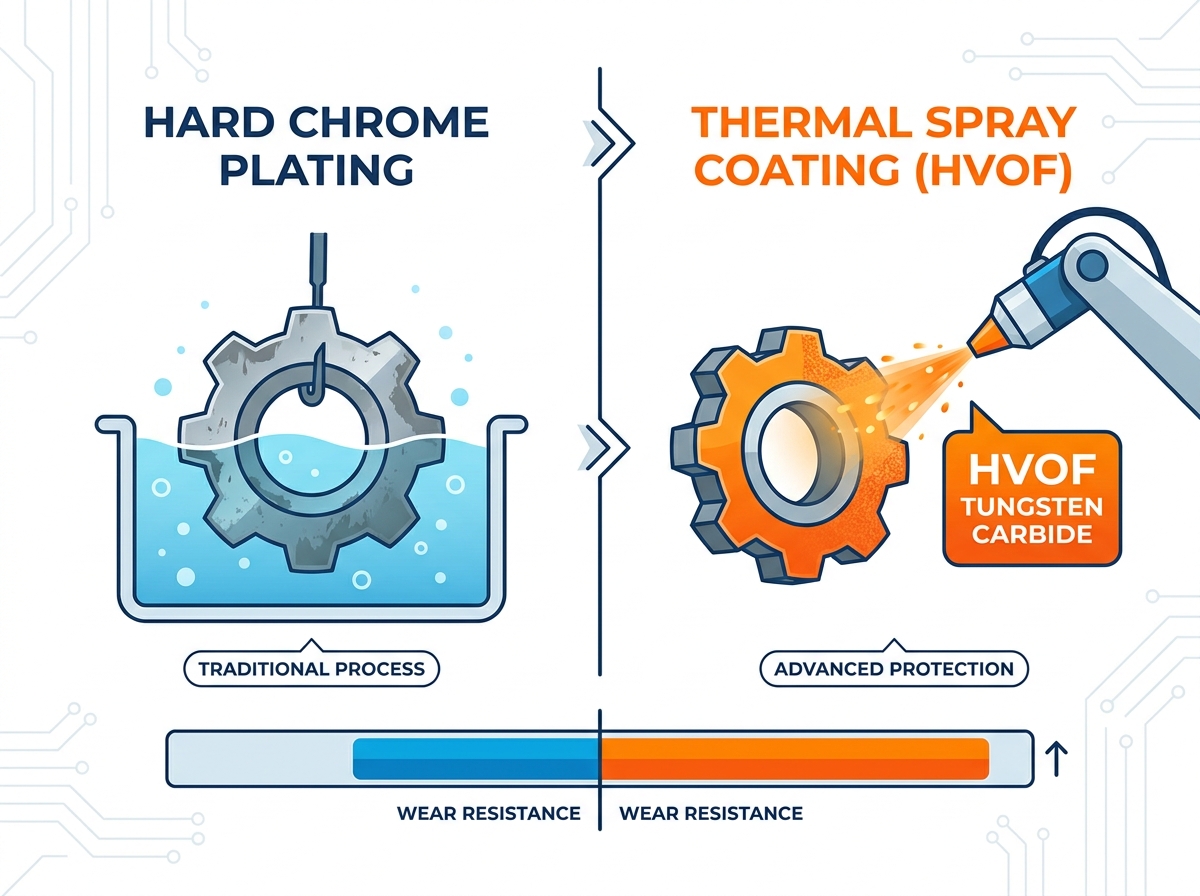
Performance Superiority: HVOF tungsten carbide coatings generally offer higher micro-hardness and superior sliding wear resistance compared to traditional hard chrome plating.
Regulatory Compliance: Thermal spray processes eliminate the severe environmental and health liabilities associated with hexavalent chromium used in hard chrome plating baths.
Structural Integrity: Unlike hard chrome, which can induce hydrogen embrittlement and micro-cracking, HVOF coatings apply compressive stresses that can improve the fatigue life of the substrate.
Application Constraints: HVOF is a line-of-sight process requiring specific component geometries and often necessitates specialized post-coating diamond grinding, impacting initial implementation costs.
Table of Contents
Engineers relied on hard chrome plating for decades to protect critical components. It provided a low coefficient of friction and acceptable general wear resistance. Hydraulic cylinders, mud pump rotors, and aerospace landing gear utilized this process extensively. The electroplating process deposits a layer of chromium onto a metal substrate using an electrolytic bath containing chromic acid. The deposition rate is slow, often requiring hours to build up a functional layer.
Hard chrome possesses inherent structural flaws that compromise long-term reliability. The coating naturally develops a micro-cracking network during deposition. These cracks form to relieve internal tensile stress as the plating builds up on the substrate. While some engineers argue these cracks hold lubricating oil, they simultaneously create direct pathways for corrosive media. Saltwater, acidic drilling muds, and industrial chemicals penetrate directly to the base substrate. This penetration causes sub-surface corrosion, leading to blistering and eventual coating delamination.
The electroplating process introduces severe hydrogen embrittlement risks. Hydrogen atoms diffuse into the base metal during the electrolytic cycle. This diffusion significantly reduces the fatigue strength of high-strength steel components, particularly those exceeding 40 HRC. Engineers must bake parts at specific temperatures immediately after plating to outgas the trapped hydrogen. Missing this narrow baking window scraps the part entirely. If baking fails or is skipped, catastrophic component failure becomes highly probable under cyclic loading.
Modern industrial applications operate at higher pressures, faster speeds, and in more aggressive environments than legacy systems. We must establish strict baseline criteria for evaluating replacement technologies. Surface hardness remains a primary indicator of wear resistance. We measure this using Vickers (HV) or Rockwell (HRC) scales. Higher hardness generally correlates with longer component life in abrasive environments, provided the coating retains sufficient fracture toughness.
Bond strength dictates whether a coating will survive heavy mechanical loading. The coating must adhere tightly to the substrate under severe shear and impact stress. We evaluate adhesion using the ASTM C633 tensile test standard. Porosity levels directly impact corrosion resistance. Lower porosity prevents aggressive chemicals from reaching the base metal. A dense microstructure is mandatory for fluid isolation in marine and chemical processing applications.
Corrosion resistance in specific environments dictates material selection. Components operating in high sulphur or oxidative environments face unique metallurgical challenges. The chosen coating must resist chemical attack while maintaining structural integrity. Dimensional restoration capabilities also matter heavily for maintenance operations. Repair teams often need to rebuild worn components to original OEM specifications. The ideal surface treatment allows for precise thickness control and predictable subsequent finishing operations.
The High-Velocity Oxygen Fuel process represents a major leap in thermal spray technology. The system combusts a mixture of oxygen and fuel gas. Common fuels include kerosene, hydrogen, or propylene. This combustion occurs inside a specialized water-cooled chamber at extremely high pressure. The thermal dynamics inside the gun dictate the final coating quality.
The expanding exhaust gases exit through a converging-diverging nozzle. This specific geometry accelerates the gas stream to supersonic speeds. Powder particles are injected radially or axially into this high-velocity gas stream. The particles heat up to a semi-molten state and accelerate toward the target component. They impact the substrate at velocities exceeding Mach 2, transferring massive kinetic energy upon collision.
This extreme kinetic energy defines the HVOF advantage over older thermal spray methods like plasma or flame spray. The particles flatten upon impact, creating dense, overlapping splats. The process utilizes high kinetic energy and relatively lower thermal energy. This combination prevents excessive melting, decarburization, and degradation of the carbide particles. The result is an ultra-dense, low-porosity coating. These coatings exhibit exceptionally high bond strengths, routinely exceeding 10,000 PSI.
Tungsten carbide is a ceramic material known for extreme hardness and wear resistance. Pure tungsten carbide is too brittle for structural applications subject to impact or flexing. Engineers combine it with a metallic binder matrix to create a tough cermet composite material. Standard HVOF tungsten carbide coating formulations include WC-Co and WC-CoCr.
The binder matrix plays a crucial role in overall coating performance. Cobalt (Co) or Cobalt-Chromium (CoCr) surrounds the hard carbide grains. The binder provides necessary fracture toughness. It allows the coating to absorb impact energy and resist crack propagation without shattering. The tungsten carbide particles provide extreme abrasion resistance against external mechanical forces.
WC-Co typically contains 12% to 17% cobalt. It excels in dry, abrasive environments where sliding wear dominates, such as wire drawing blocks or paper mill rolls. WC-CoCr adds chromium to the matrix, typically in an 86WC-10Co-4Cr ratio. This addition significantly enhances corrosion resistance. The chromium forms a passive oxide layer that protects the underlying matrix from chemical attack. Engineers select the specific powder morphology and chemistry based on the exact operating environment.
Surface hardness directly dictates a component's ability to resist wear and deformation. Hard chrome plating typically achieves hardness values between 800 and 1000 HV0.3. This provides adequate protection for standard, low-cycle industrial applications. Modern operations often exceed these limits, causing rapid chrome degradation, scoring, and galling.
An HVOF tungsten carbide coating consistently outperforms chrome in hardness. Typical values range from 1100 to over 1400 HV0.3. This massive increase in micro-hardness translates to superior wear resistance across multiple failure modes. We analyze performance across three specific wear scenarios to understand the practical field benefits.
Sliding wear occurs when two surfaces rub together under load, such as a hydraulic rod passing through a seal. Tungsten carbide maintains a low coefficient of friction when polished to a low Ra finish. It resists galling and adhesive wear far better than chrome. Abrasive wear involves hard particles gouging the surface. The extreme hardness of the carbide grains deflects these particles, preventing deep scratches. Erosive wear happens when fluid-borne particles strike the component at high velocity. The tough binder matrix prevents the carbide grains from dislodging under continuous impact.
Performance Metric | Hard Chrome Plating | HVOF Tungsten Carbide |
|---|---|---|
Micro-Hardness (HV0.3) | 800 - 1000 | 1100 - 1400+ |
Porosity | Micro-cracked network | < 1% (Ultra-dense) |
Bond Strength (ASTM C633) | Metallurgical (Electroplated) | > 10,000 PSI (Mechanical) |
Abrasive Wear Resistance | Moderate | Exceptional |
Fatigue Impact on Substrate | Reduces fatigue strength (Tensile) | Improves fatigue strength (Compressive) |
Deposition Rate | Slow (Hours) | Fast (Minutes) |
Corrosion resistance depends heavily on coating density and structural integrity. Hard chrome relies on a micro-cracked structure. These cracks inevitably allow moisture, salts, and chemicals to penetrate. Engineers often apply multiple layers or specify a nickel understrike to offset this flaw. This approach only delays the inevitable substrate corrosion and adds processing time.
HVOF coatings feature a dense, overlapping splat structure. Porosity levels consistently measure below 1%. This dense barrier effectively seals the base metal from the environment. Corrosive media cannot find a direct path through the coating. The substrate remains protected even in harsh chemical washes or continuous saltwater submersion.
High-temperature and sulphidizing environments require careful material selection. As a general engineering rule, high chrome content is advisable for resistance to oxidization and sulphur at elevated temperatures. Standard tungsten carbide oxidizes rapidly above 900°F (480°C), converting to a soft oxide that quickly wears away.
Advanced HVOF formulations bridge this performance gap. Utilizing a Cobalt-Chromium binder (WC-CoCr) provides superior localized corrosion resistance. This formulation excels in marine and chemical environments. It matches or exceeds hard chrome's protective capabilities without the associated environmental hazards. For extreme temperatures exceeding 900°F, engineers switch to Chromium Carbide (Cr3C2-NiCr) formulations, which maintain hardness and resist oxidation up to 1500°F (815°C).
Surface treatments alter the mechanical properties of the base metal. We must evaluate the thermal and mechanical impact of each process. Electroplating operates at relatively low temperatures. It imparts residual tensile stress into the coating structure as the chromium lattice forms.
This tensile stress encourages crack propagation. Combined with hydrogen embrittlement, hard chrome significantly reduces substrate fatigue strength. Cyclic loading causes premature failure in plated high-strength steel components. Aerospace, mining, and heavy lifting applications view this as a critical failure mode that requires constant non-destructive testing (NDT) monitoring.
The HVOF process imparts beneficial compressive residual stresses. The high-velocity impact of the particles peens the surface during deposition. This peening effect creates a compressive stress layer. Compressive stress actively resists crack formation and propagation. Consequently, an HVOF tungsten carbide coating improves the fatigue life of the substrate. The substrate remains relatively cool during spraying, typically staying below 300°F (150°C) through the use of compressed air cooling jets. This prevents metallurgical changes, warping, or loss of heat treatment in the base metal.
The regulatory landscape is rapidly shifting against legacy plating. Hexavalent chromium (Cr6+) is a known human carcinogen. Regulatory bodies worldwide are driving its obsolescence. REACH regulations in Europe heavily restrict its industrial use, requiring special authorizations that are increasingly difficult to obtain. OSHA and the EPA enforce strict permissible exposure limits (PEL) in the United States.
Maintaining hard chrome plating lines introduces massive compliance liabilities. Facilities require extensive ventilation, fume hoods, and wet air scrubbing systems. Workers must wear specialized personal protective equipment, including respirators. Medical monitoring programs are mandatory for exposed personnel. These requirements strain operational resources and inflate overhead costs.
Waste disposal presents another significant hurdle. Spent plating baths classify as hazardous waste. Treatment and disposal costs continue to escalate annually. Spills or leaks lead to catastrophic environmental contamination and massive fines. The associated legal and financial risks force companies to seek sustainable alternatives.
Thermal spray offers a vastly superior environmental profile. The HVOF process does not utilize toxic chemical baths. It eliminates the generation of hazardous liquid waste entirely. This removes the risk of groundwater contamination. Facilities operate without the constant threat of chemical spills or the need for complex wastewater treatment plants.
The primary byproduct of HVOF is overspray powder. Facilities manage this using localized dust collection systems. High-efficiency particulate air (HEPA) filters capture the airborne dust directly at the spray booth. The captured powder is dry and contained. Operators handle it safely without specialized chemical suits.
Many facilities implement powder recycling programs. They collect and sell the overspray to metal recyclers who reclaim the tungsten and cobalt. This transition from chemical disposal to powder recycling is highly beneficial. It frames HVOF as a sustainable, long-term operational choice. It aligns with modern corporate environmental, social, and governance (ESG) goals.
Evaluating surface treatments requires looking beyond the initial application price. HVOF tungsten carbide coating often requires higher initial capital for equipment and specialized post-coating machining compared to the standard grinding of hard chrome. The raw powder materials cost more than chromic acid.
Machining HVOF coatings demands specific tooling. The extreme hardness of tungsten carbide destroys standard aluminum oxide or silicon carbide grinding wheels. Shops must use resin-bonded diamond wheels with specific grit sizes (typically D126 for roughing, D46 for finishing). Copious amounts of synthetic coolant are required to prevent heat checking the coating during grinding. These specialized machining requirements increase the upfront manufacturing time and cost.
Machining Parameter | Hard Chrome | HVOF Tungsten Carbide |
|---|---|---|
Abrasive Media | Aluminum Oxide / Silicon Carbide | Resin-Bonded Diamond |
Coolant Requirement | Standard Water-Soluble | High-Lubricity Synthetic |
Material Removal Rate | High | Low (Requires light passes) |
Achievable Surface Finish | < 4 Ra (Micro-inches) | < 2 Ra (Micro-inches) with lapping |
The true economic value of HVOF emerges during field operation. Engineers model the long-term ROI by calculating the value of extended Mean Time Between Failures (MTBF). Components coated with HVOF routinely outlast chrome-plated equivalents by a factor of three to five in severe abrasive environments.
The superior wear life of tungsten carbide reduces maintenance intervals. Fewer rebuilds mean lower replacement part costs and drastically reduced labor hours. Most importantly, it minimizes lost production time. In industries like offshore drilling or continuous paper manufacturing, an hour of downtime costs tens of thousands of dollars. The operational savings generated by keeping machinery running far offset the higher initial application and machining costs.
Thermal spray possesses primary physical limitations. HVOF is strictly a line-of-sight process. The spray torch must have direct access to the target surface. The particles travel in a straight line from the nozzle. They cannot wrap around corners, coat hidden undercuts, or penetrate deep recesses.
This creates challenges for complex geometries. Internal diameters (IDs) are particularly difficult to coat. Standard HVOF torches cannot fit inside small bores. The spray angle must remain close to 90 degrees for optimal bonding and density. Shallow spray angles result in high porosity, poor adhesion, and excessive overspray waste.
Engineers employ specific mitigation strategies. Specialized miniaturized ID HVOF torches coat bores down to roughly 4 inches (100mm). For smaller IDs, alternative processes are necessary. Engineers specify laser cladding, specialized nitriding, or electroless nickel for non-accessible areas. Proper component design accounts for torch access and masking requirements during the engineering phase.
Practical limits exist for coating thickness in both processes. Hard chrome can be plated very thick, sometimes exceeding 0.050 inches for heavy salvage work. Thicker chrome layers increase the severity of micro-cracking, which compromises the structural integrity of the plating.
HVOF coatings require strict thickness management. Typical applied thickness ranges from 0.003 to 0.015 inches. The compressive residual stresses build up as the coating gets thicker. If applied too thickly, these stresses exceed the bond strength. The coating will literally push itself off the substrate.
This excessive stress leads to catastrophic spalling or delamination. Engineers manage residual stress through careful parameter control. They adjust spray distance, traverse speed, and cooling rates to maintain thermal equilibrium. Proper application ensures the coating remains intact under severe mechanical loads.
Consistent quality requires rigorous testing and validation. You must define critical QA metrics for HVOF applications on your engineering drawings. Metallographic evaluation is paramount. Technicians cross-section a coated test coupon and examine it under a microscope. They verify coating density, interface cleanliness, and uniform thickness.
Perform ASTM C633 tensile testing to verify bond strength exceeds 10,000 PSI.
Conduct metallographic cross-section analysis to ensure porosity remains below 1%.
Execute Almen strip testing to confirm the presence of compressive residual stress.
Utilize magnetic particle inspection (MPI) on the base metal prior to spraying to ensure no pre-existing cracks exist.
Selecting a capable thermal spray partner is critical. Look for facilities with automated, robotic spray cells. Manual spraying cannot provide the necessary parameter control or consistent standoff distance. The partner must demonstrate consistent, repeatable results. Request historical test data, equipment calibration records, and operator certifications before awarding contracts.
Use a clear decision matrix for your engineering specifications. Recommend hard chrome only for specific legacy systems where re-engineering is impossible or geometries strictly forbid line-of-sight spray. Recommend HVOF for all new designs, heavy wear components like hydraulic rods, pump housings, and valves, and environments requiring strict regulatory compliance.
Conduct a lifecycle cost analysis on your most frequently replaced components to identify prime candidates for HVOF upgrades.
Request metallurgical test data for WC-CoCr formulations from prospective thermal spray vendors.
Initiate a prototype coating run with a certified, robotically controlled thermal spray provider.
Evaluate the prototype under actual field conditions to verify performance gains against legacy chrome parts.
A: HVOF tungsten carbide is significantly harder. We measure this using the Vickers microhardness scale. Hard chrome typically achieves values between 850 and 1000 HV0.3. In contrast, an HVOF tungsten carbide coating routinely exceeds 1200 HV0.3, often reaching up to 1400 HV0.3. This massive increase in surface hardness translates directly to superior sliding and abrasive wear resistance in severe industrial environments.
A: It depends on the bore size. HVOF is strictly a line-of-sight process. Standard spray torches require direct access and a near-perpendicular spray angle. Specialized miniaturized HVOF torches can coat internal diameters down to approximately 4 inches (100mm). For smaller internal diameters or complex geometries that block the spray path, alternative surface treatments or specialized plating methods remain necessary.
A: Yes, it almost always requires post-machining. The HVOF process leaves a relatively rough, as-sprayed surface finish. This roughness is unsuitable for dynamic seals or precision fits. To achieve tight dimensional tolerances and low Ra surface finishes, the coating requires specialized diamond grinding or lapping. Standard aluminum oxide or silicon carbide grinding wheels cannot effectively machine tungsten carbide.
A: Hard chrome relies on a metallurgical bond created through electrodeposition. HVOF creates a purely mechanical bond. The supersonic particles impact the roughened substrate, flattening and interlocking with the surface profile. Despite being mechanical, the bond strength of HVOF is exceptional. When tested to ASTM C633 standards, HVOF bond strengths frequently exceed 10,000 PSI, providing incredible resistance to delamination under heavy loads.
A: Standard tungsten carbide begins to oxidize rapidly at temperatures around 900°F (480°C). Above this threshold, the coating degrades and loses its wear-resistant properties. For environments requiring extreme resistance to oxidization and sulphur at higher temperatures, engineers must switch formulations. Alternative HVOF chemistries, such as Chromium Carbide (Cr3C2-NiCr), are highly recommended over standard WC for high-temperature applications.
A: No, it is not. Hard chrome plating naturally develops a micro-cracked network to relieve internal tensile stress during deposition. HVOF coatings operate differently. The high-velocity impact of the powder particles peens the surface, imparting beneficial compressive residual stresses. This compressive nature prevents the formation of inherent micro-cracking networks, resulting in an ultra-dense coating that effectively seals out corrosive media.