Author: Site Editor Publish Time: 2026-08-11 Origin: Site
Premature component failure in high-stress industrial environments is rarely a material defect. It usually points to a misalignment between the operating environment and the applied thermal spray coating. When pump impellers, hydraulic rods, or gas turbine blades degrade ahead of schedule, the root cause frequently traces back to the specific coating application method. Engineers and procurement teams must choose between Plasma Spray, HVOF, and HVAF. Selecting the wrong process leads to excessive porosity, substrate distortion from heat stress, or catastrophic coating delamination. This drives up maintenance cycles and operational downtime.
Navigating this decision requires moving beyond basic material compatibility. You must evaluate the kinetic versus thermal energy balance of each process. This guide breaks down the mechanics, comparative advantages, empirical benchmarks, and critical configuration requirements to determine the right coating technology for your application.
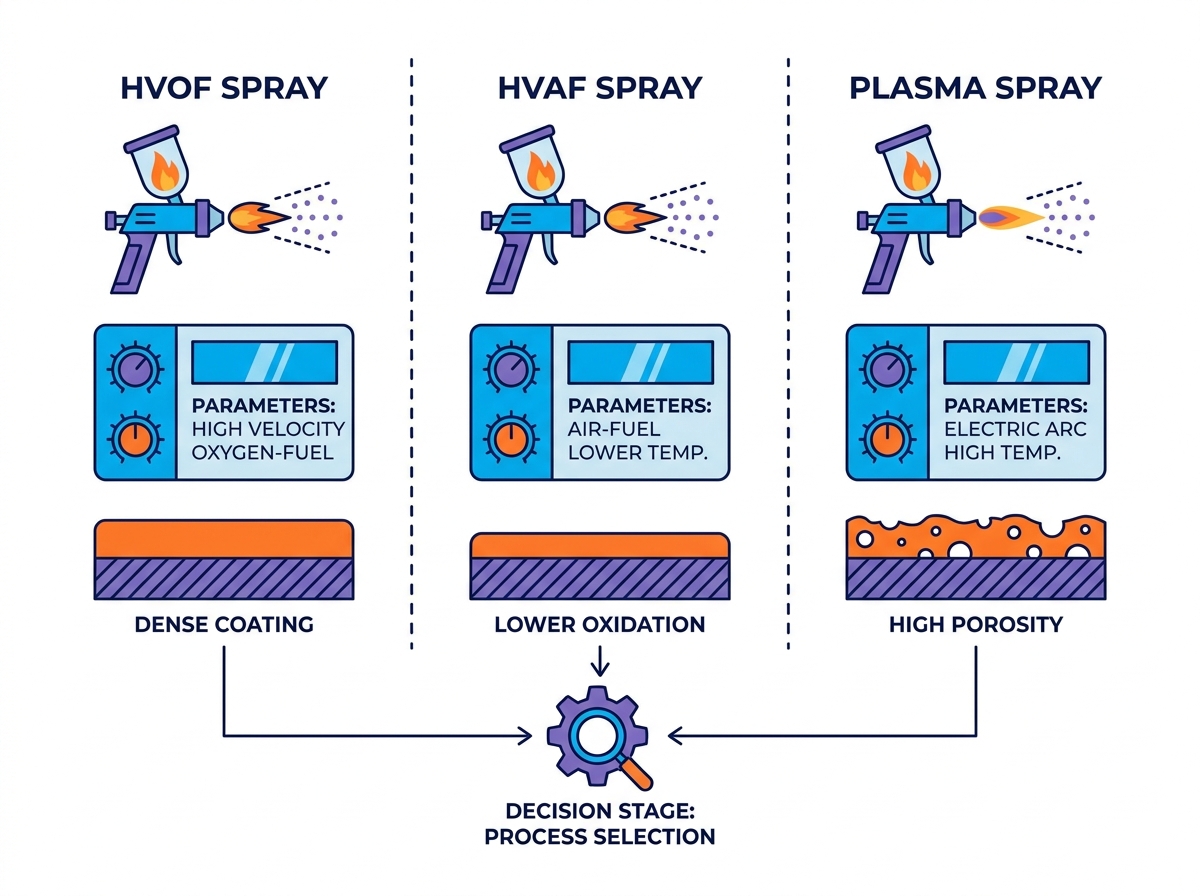
Plasma Spray is the optimal choice for applying high-melting-point ceramics and protecting components with complex geometries, extreme heat stress requirements, or exceptionally large surface areas.
HVOF (High-Velocity Oxygen Fuel) remains the industry standard for dense, wear-resistant metallic and carbide coatings, though success depends heavily on strictly controlling HVOF spray parameters to prevent carbide degradation.
HVAF (High-Velocity Air Fuel) operates at lower temperatures but higher velocities than HVOF, consistently yielding superior fracture toughness and lower oxidation in Tungsten Carbide (WC) coatings while serving as a direct strategy to cut operational gas costs.
Decision Driver: The choice ultimately hinges on the required balance of thermal energy (melting the powder) versus kinetic energy (impact density), alongside substrate temperature limits.
Table of Contents
When evaluating failure modes, you must differentiate between sliding wear, hard-particle abrasion, and fluid-driven erosion. A pump impeller handling silica sand slurry faces severe erosive wear. This requires a coating with high fracture toughness to absorb particle impacts without micro-chipping. Conversely, a hydraulic cylinder rod operating in a marine environment needs a dense, impermeable barrier to block saltwater corrosion while resisting sliding wear against polymer seals.
You must define the exact coating thickness required. Clear specifications regarding acceptable porosity levels and minimum bond strength dictate the required kinetic energy of the spray process. Bond strength is typically measured in megapascals (MPa) via ASTM C633 testing. A coating designed to resist mild atmospheric oxidation has vastly different density requirements than a coating submerged in highly acidic chemical processing fluids.
Thermal spray processes introduce massive heat loads into the component. Evaluating the base material’s metallurgical limits prevents irreversible damage during application. Aluminum and magnesium alloys possess much lower melting points and heat tolerances than carbon steel or titanium.
You must define the maximum allowable substrate temperature during spraying. For many high-strength aerospace steels, exceeding 150°C (300°F) can lead to localized annealing, warping, or fundamental alterations of the component's mechanical temper. High-heat processes require aggressive, continuous cooling strategies. This often involves mounting liquid carbon dioxide or compressed air jets directly onto the spray gun manipulator to extract heat as fast as the flame applies it.
Thermal spray is strictly a line-of-sight process. High-velocity methods rely on perpendicular spray angles to achieve optimal particle compaction. Assess the component for complex internal diameters, deep grooves, or intricate profiles. Coating the internal bore of a pipe requires specialized ID (Internal Diameter) extension guns, which operate at different energy levels than standard OD (Outside Diameter) torches.
Evaluate the overall scale of the project. Extremely large surface areas favor processes with wider spray plumes or higher deposition efficiencies. Coating a massive industrial boiler wall requires a different logistical approach than precision-coating a small aerospace actuator rod. You must match the spray rate of the equipment to the physical scale of the target component.
Before any thermal spray process begins, the substrate requires aggressive surface preparation. Machined surfaces are too smooth for mechanical bonding. Operators must grit blast the component using angular aluminum oxide or chilled iron grit to achieve a specific surface roughness profile. This is typically an Ra of 3 to 6 micrometers. This jagged topography provides the necessary anchor pattern for the initial layer of semi-molten particles to grip. Failing to achieve the correct surface profile guarantees premature coating delamination, regardless of the spray process used.
Plasma spray utilizes an ionized gas plasma plume to melt feedstock powder. An electric arc generates the plasma by ionizing inert gases. Operators typically use argon mixed with secondary diatomic gases like hydrogen or helium to increase thermal conductivity. As the gas expands and accelerates out of the nozzle, it creates a massive thermal core.
This process reaches extreme temperatures, often peaking up to 16,000°C. These unparalleled thermal capabilities allow for the complete melting of refractory metals and high-melting-point ceramics. The feedstock powder is injected directly into this plasma plume via a carrier gas. The particles rapidly absorb heat, melt into fully liquid droplets, and are propelled toward the prepared substrate.
The primary domain of plasma spray involves materials that other processes simply cannot melt. Thermal barrier coatings (TBCs) in aerospace gas turbines rely almost exclusively on plasma-sprayed yttria-stabilized zirconia. These coatings protect turbine blades from catastrophic heat degradation by providing an insulating layer between the superalloy substrate and the combustion gases.
Plasma spray also excels in applying dielectric coatings for electrical insulation and clearance control coatings in compressor casings. Furthermore, it is highly effective for coating parts with complex geometries or exceptionally large surface areas where achieving high-velocity impact is impossible or operationally impractical.
While thermal energy is immense, kinetic energy remains relatively low. Particle velocity in atmospheric plasma spray typically stays below 300 meters per second. This is significantly slower than combustion-driven high-velocity methods.
The lower impact velocity results in higher coating porosity, generally ranging from 1% to 5%. The splat formation relies entirely on thermal flattening rather than kinetic compaction. The liquid droplets hit the surface, spread out, and freeze rapidly. Consequently, plasma-sprayed coatings exhibit lower mechanical bond strength and lower overall density compared to their high-velocity counterparts. This makes them less suitable for severe abrasive wear environments where point-loading can cause porous coatings to fail.
The High-Velocity Oxygen Fuel process relies on the continuous combustion of pure oxygen and a fuel source. Fuels can be gaseous, such as propylene, propane, or hydrogen, or liquid, such as aviation-grade kerosene. This high-pressure combustion occurs within a confined water-cooled chamber. The expanding exhaust gases are then forced through a converging-diverging de Laval nozzle.
This specific nozzle geometry accelerates the gas stream to supersonic speeds. HVOF strikes a precise balance, generating moderate flame temperatures up to 3,000°C while achieving extreme particle velocities up to 1,000 meters per second. The powder is injected axially or radially into the combustion chamber or nozzle. The particles heat to a semi-molten state before impacting the substrate with massive kinetic force, forging a dense mechanical bond.
Achieving a dense, defect-free coating requires meticulous calibration of specific HVOF spray parameters. Minor deviations in these settings drastically alter the coating's microstructure, phase composition, and field performance.
Fuel-to-Oxygen Ratio: Stoichiometric adjustments control the exact flame temperature and chemistry. Running a slightly fuel-rich flame prevents the decarburization of sensitive carbide powders. This ensures the hard tungsten carbide phases do not degrade into brittle metallic tungsten or W2C during flight.
Spray Distance (Stand-off): The distance between the nozzle and the substrate dictates particle dwell time. Operators strictly maintain stand-off distances between 200mm and 350mm. Moving the gun too close scorches the substrate, while moving it too far allows the particles to decelerate and cool, resulting in a porous coating.
Powder Feed Rate and Carrier Gas Flow: Mass flow directly affects particle heating uniformity. Typical feed rates range from 30 to 100 grams per minute. Overloading the plume with powder drops the overall flame temperature, leading to unmelted particles and weak inter-splat boundaries.
Gun Traverse Speed: Traverse speed determines the coating thickness applied per pass. Faster traverse speeds apply thinner layers. This is necessary for managing residual stress and preventing heat buildup in the base metal.
HVOF is globally recognized for producing exceptionally high-density coatings with excellent wear resistance. It serves as the primary technology for hard chrome replacement in hydraulic cylinders and landing gear. The kinetic compaction creates coatings with porosity well below 1%.
However, the process carries a significant risk of substrate overheating due to high thermal transfer from the combustion flame. Operators must implement aggressive cooling techniques. Additionally, the reliance on high volumes of pure oxygen introduces complex gas logistics and higher operational consumption rates compared to air-breathing systems. A typical kerosene-based HVOF system might consume 800 to 900 liters per minute of oxygen, requiring bulk liquid oxygen tanks on site.
High-Velocity Air Fuel represents an evolution in combustion spray technology. It substitutes pure oxygen with highly compressed air. The process utilizes a catalytic or spark-ignited combustion chamber followed by a specialized nozzle to generate supersonic gas jets.
This substitution causes a fundamental operational shift. The nitrogen present in the compressed air acts as a thermal buffer and cooling agent. This results in lower flame temperatures, typically between 1,900°C and 2,000°C. Simultaneously, the massive volume of expanding air generates significantly higher gas and particle velocities, often exceeding 1,200 meters per second. Particles are heated just enough to soften, relying almost entirely on kinetic energy for severe plastic deformation upon impact.
The lower operating temperature of HVAF provides a massive metallurgical advantage when spraying Tungsten Carbide (WC) powders. Tungsten carbide is highly susceptible to thermal degradation. Excessive heat causes it to oxidize and form brittle phases.
Because HVAF operates below the severe degradation threshold of WC, it ensures minimal oxidation and prevents embrittlement. The powder retains its original phase composition from the hopper to the substrate. Empirical metallurgical test results demonstrate that HVAF produces WC-based coatings with fracture toughness substantially exceeding known HVOF benchmarks.
These resulting ductile, high-fracture-toughness coatings resist impact, flexing, and cavitation far better than standard HVOF coatings. When a component bends under heavy mechanical load, an HVAF coating is less likely to micro-crack, extending the operational life of the part in dynamic environments.
Upgrading to HVAF equipment provides a distinct operational advantage by eliminating the need for pure oxygen. Removing oxygen cylinders or bulk liquid oxygen tanks simplifies facility logistics, reduces safety hazards associated with pure oxygen handling, and streamlines supply chains.
Furthermore, HVAF systems generally boast higher spray rates and superior deposition efficiencies. More powder adheres to the part per hour, reducing overall spray time. The smoother as-sprayed surface finish of HVAF coatings also requires less post-spray grinding and machining, accelerating total production throughput.
Coating integrity is primarily measured by density and bond strength. Plasma spray, relying on thermal flattening, typically yields porosity levels between 1% and 5%. This is acceptable for thermal barriers but insufficient for severe corrosion protection.
HVOF utilizes kinetic compaction to drive porosity below 1%, creating dense microstructures with high mechanical bond strengths. HVAF pushes this further. By increasing velocity and reducing thermal degradation, HVAF frequently achieves porosity levels below 0.5%. For WC-based coatings, empirical data shows HVAF consistently delivers the highest bond strength and cohesive strength among the three methods.
Selecting the right process requires mapping the feedstock material to the correct energy profile. Materials that require massive thermal energy to melt must utilize Plasma Spray. This includes all high-temperature ceramics and refractory oxides.
Conversely, materials that degrade under high heat but require extreme density must utilize kinetic energy. Carbides and metallic alloys fall into this category. HVOF provides a balanced thermal-kinetic profile, while HVAF maximizes kinetic energy while actively suppressing thermal input. Fine-tuning HVOF spray parameters can bridge the gap, but HVAF remains inherently cooler.
Process | Typical Flame Temp (°C) | Max Particle Velocity (m/s) | Typical Porosity | Ideal Feedstock Materials |
|---|---|---|---|---|
Plasma Spray | Up to 16,000 | < 300 | 1% - 5% | Ceramics, Zirconia, Refractory Metals |
HVOF | Up to 3,000 | Up to 1,000 | < 1.0% | Tungsten Carbide, Chrome Replacements, Inconel |
HVAF | 1,900 - 2,000 | 1,200+ | < 0.5% | Tungsten Carbide, Ductile Metals, Anti-Cavitation |
Throughput capabilities dictate how effectively a process integrates into high-volume manufacturing versus one-off repair jobs. Plasma spray systems are highly versatile for diverse repair shops handling various materials. However, their deposition rates for metals are generally lower.
HVOF provides excellent throughput for heavy industrial applications but requires frequent consumable replacements. The extreme internal heat degrades combustion chamber hardware and nozzles rapidly. HVAF operates cooler internally, which drastically extends the lifespan of consumable spare parts. Combined with higher deposition efficiencies, HVAF offers superior scalability for continuous, high-volume production lines.
Process | Primary Oxidizer | Cooling Requirements | Consumable Wear Rate |
|---|---|---|---|
Plasma Spray | None (Inert Gases) | Moderate (Air Jets) | Low to Moderate (Electrodes) |
HVOF | Pure Oxygen | High (CO2 or Heavy Air) | High (Nozzles, Chambers) |
HVAF | Compressed Air | Moderate to High | Low (Cooler internal temps) |
Thermal spray inherently induces residual stress within the coating and the substrate. To quantify this stress, engineers utilize Almen strip testing. A thin strip of spring steel is clamped to a block and sprayed. Once unclamped, the strip bends. The direction and magnitude of the curvature indicate the type and severity of the residual stress.
Plasma spray typically generates tensile stress. As the fully molten droplets hit the cold substrate, they quench and contract. If applied too thickly, tensile stress causes the coating to crack or peel away from the edges. High-velocity processes generate compressive stress. The intense kinetic impact acts like shot peening, compacting the layers. While compressive stress allows for much thicker coatings without cracking, the high heat transfer can warp the substrate. Operators must implement robust cooling strategies, utilizing compressed air jets or liquid CO2 cooling directly on the part during the spray cycle to maintain substrate dimensional stability.
Industrial thermal spray requires significant infrastructure. The extreme velocities of HVOF and HVAF generate noise levels frequently exceeding 130 dB. Operating this equipment in an open shop floor is strictly prohibited. Specialized, heavily insulated soundproof booths are mandatory to protect personnel from permanent hearing damage.
Furthermore, atomized metal and carbide powders present severe respiratory and explosive hazards. Facilities must install high-capacity dust collection and ventilation systems. Compliance with combustible dust safety regulations requires explosion-proof ducting, wet scrubbers, and strict housekeeping protocols to prevent catastrophic facility incidents.
There is no universal best thermal spray process. The correct selection is dictated entirely by the feedstock material, the substrate's thermal limits, the scale of the surface area, and the specific wear environment the component will endure. Choose Plasma Spray for ceramics and complex geometries. Choose HVOF for established metallic coatings where precise parameter control is validated. Choose HVAF for next-generation carbide coatings requiring maximum fracture toughness.
To move forward effectively, execute the following steps:
Conduct a metallurgical evaluation of sample coupons sprayed with your target material using both HVOF and HVAF to compare fracture toughness and porosity.
Review OEM specifications to ensure the chosen process aligns with required bond strength limits and maximum allowable substrate temperatures.
Evaluate your facility's capacity for handling pure oxygen versus compressed air to determine logistical feasibility and safety compliance.
Consult with a thermal spray integrator to finalize equipment selection and establish baseline cooling protocols for your specific component geometry.
A: The primary difference is the oxidizer used for combustion. HVOF uses pure oxygen, creating higher flame temperatures and moderate supersonic velocities. HVAF uses compressed air, resulting in lower flame temperatures but significantly higher particle velocities, which reduces thermal degradation of the powder.
A: Parameters like fuel-to-oxygen ratio, powder feed rate, and stand-off distance directly dictate particle melting and impact velocity. Incorrect parameters lead to unmelted particles or insufficient kinetic energy upon impact, which creates voids and drastically increases the porosity of the final coating.
A: While possible, it is highly discouraged. Plasma spray generates extreme temperatures that easily overheat and oxidize Tungsten Carbide, degrading it into brittle phases. High-velocity processes like HVOF or HVAF are required to retain the carbide's hardness and wear resistance.
A: HVAF eliminates the need for pure oxygen, relying instead on facility compressed air. This removes complex oxygen logistics. Additionally, HVAF generally offers higher deposition rates and produces smoother as-sprayed finishes, reducing the time required for post-spray grinding and machining.
A: For carbide and metallic coatings, HVAF consistently provides the highest bond strength and fracture toughness. Its extreme kinetic energy ensures dense compaction, while its lower temperature prevents the embrittlement of hard phases, resulting in a highly ductile, impact-resistant coating.
A: Preventing warping requires strict heat management. Operators must optimize gun traverse speeds to apply thinner layers per pass, maintain proper stand-off distances, and utilize aggressive external cooling methods, such as compressed air jets or liquid CO2, directed at the substrate during spraying.