Author: Site Editor Publish Time: 2026-08-11 Origin: Site
Sourcing thermal spray coatings involves managing complex operational variables rather than relying on a simple flat rate. Component failure in severe industrial environments presents massive financial risks. Surface engineering quotes often seem opaque to procurement and engineering teams. The global thermal spray market continues to expand rapidly, driven by industries shifting away from solid superalloys toward targeted surface treatments to optimize performance. Accurately forecasting these investments requires evaluating application methods, material choices, and stringent quality benchmarks.
The final investment is dictated by specific performance specifications. Engineers must balance the required coating density against the operational environment. Specifically, requirements like achieving low HVOF coating porosity heavily drive the required equipment and consumable inputs. Understanding the intersection of these technical requirements allows teams to accurately assess quotes and select the appropriate surface engineering strategy.
Performance Dictates Price: The cost of thermal spray is directly proportional to the required coating density and bond strength; achieving near-zero HVOF coating porosity requires higher-tier equipment and consumables.
Protection-Specific Pricing: Costs scale based on the primary environmental threat being mitigated—basic corrosion protection is highly economical, while extreme heat (thermal barrier coatings) and severe wear (carbides) require premium processes.
Base Material Economics: Applying a premium thermal spray coating to a low-cost carbon steel substrate is consistently more cost-effective than manufacturing the entire component from expensive superalloys.
In-House vs. Outsourced: Capital expenditures for thermal spray systems require significant investment, making outsourced service providers the most viable financial route for low-to-medium volume production.
Hidden Cost Drivers: Surface preparation, complex masking, industrial gas consumption, and post-coating machining often account for a larger percentage of the total project cost than the spray process itself.
Table of Contents
Service providers calculate quotes using a complex matrix of variables that extend far beyond raw material consumption. Defining the baseline success criteria is the first step in understanding surface engineering investments. The final number reflects the labor, energy, and precision required to meet specific engineering tolerances.
The feedstock material fundamentally shapes the baseline investment. Common materials like zinc and aluminum wires represent the most economical end of the spectrum. These wires melt easily and deposit rapidly, making them ideal for large-scale atmospheric protection. Engineered powders, such as tungsten carbide or chrome carbide, represent a higher investment tier. These specialized materials provide superior wear resistance but require sophisticated equipment to apply.
Powder morphology and manufacturing methods directly impact deposition efficiency. Agglomerated and sintered powders offer excellent flowability and consistent melting characteristics. The manufacturing process involves mixing fine carbide grains with a metallic binder, spray-drying them into spherical agglomerates, and sintering them at high temperatures. This creates a robust particle that melts evenly in the spray plume. Conversely, cast and crushed powders present different density profiles and melting behaviors. They are manufactured by melting the constituents, casting them into an ingot, and mechanically crushing them into angular particles. The manufacturing method dictates how efficiently the powder transfers to the substrate, influencing the total material required for a project. Particle size distribution also plays a massive role; powders sifted to a tight tolerance flow more consistently but command a higher premium.
Thermal spray relies on line-of-sight application. Complex geometries significantly increase processing time and labor. Internal bores, deep undercuts, and sharp transitions require specialized torch extensions and precise robotic programming. The spray plume must remain perpendicular to the surface to ensure optimal bonding and density. If a component features multiple intersecting angles, the robot must be programmed to maintain this strict standoff distance and angle throughout the entire tool path.
Protecting non-coated areas introduces substantial labor and material requirements. Precision masking is rarely a simple process. Operators utilize specialized high-temperature fiberglass tapes, custom-machined copper shadow masks, and UV-curable resins. Applying and removing these materials often consumes more labor hours than the actual spraying process. If a pump impeller requires coating only on the bearing journals, the entire volute and blade assembly must be meticulously protected from overspray and grit blasting damage.
Mechanical bonding relies entirely on proper surface preparation. Coatings will fail catastrophically without a properly profiled substrate. The preparation process involves rigorous degreasing to remove all surface contaminants, followed by precise grit blasting using angular aluminum oxide or chilled iron grit. The blasting process creates an anchor pattern that allows the molten particles to interlock with the substrate.
Maintaining strict environmental controls during preparation prevents flash rusting. Compressed air lines must feature heavy-duty oil and water traps; even microscopic moisture contamination on the blasted surface will compromise the mechanical bond. The required depth of this anchor pattern varies based on the coating material and application method, requiring operators to carefully select the correct grit size and blasting pressure for each specific job.
Hourly spray booth rates must account for massive energy and consumable consumption. Industrial gas usage represents a major hidden variable in surface engineering. High-velocity and plasma systems consume vast quantities of oxygen, hydrogen, argon, and helium. Maintaining precise stoichiometric ratios is essential for coating quality, meaning gas flow rates must be strictly controlled via expensive mass flow controllers. A slight deviation in gas pressure can alter the flame temperature, leading to unmelted particles or oxidized powder.
Electricity consumption further compounds the operational overhead. Plasma systems require massive power supplies to generate the electrical arc, often drawing hundreds of amps during continuous operation. Heavy-duty industrial chillers run continuously to circulate deionized water through the torch body, preventing the internal copper components from melting under extreme heat. Dust collection systems and high-capacity ventilation fans draw significant power to maintain safe atmospheric conditions within the spray cell, filtering out hazardous metallic dust before exhausting air outside the facility.
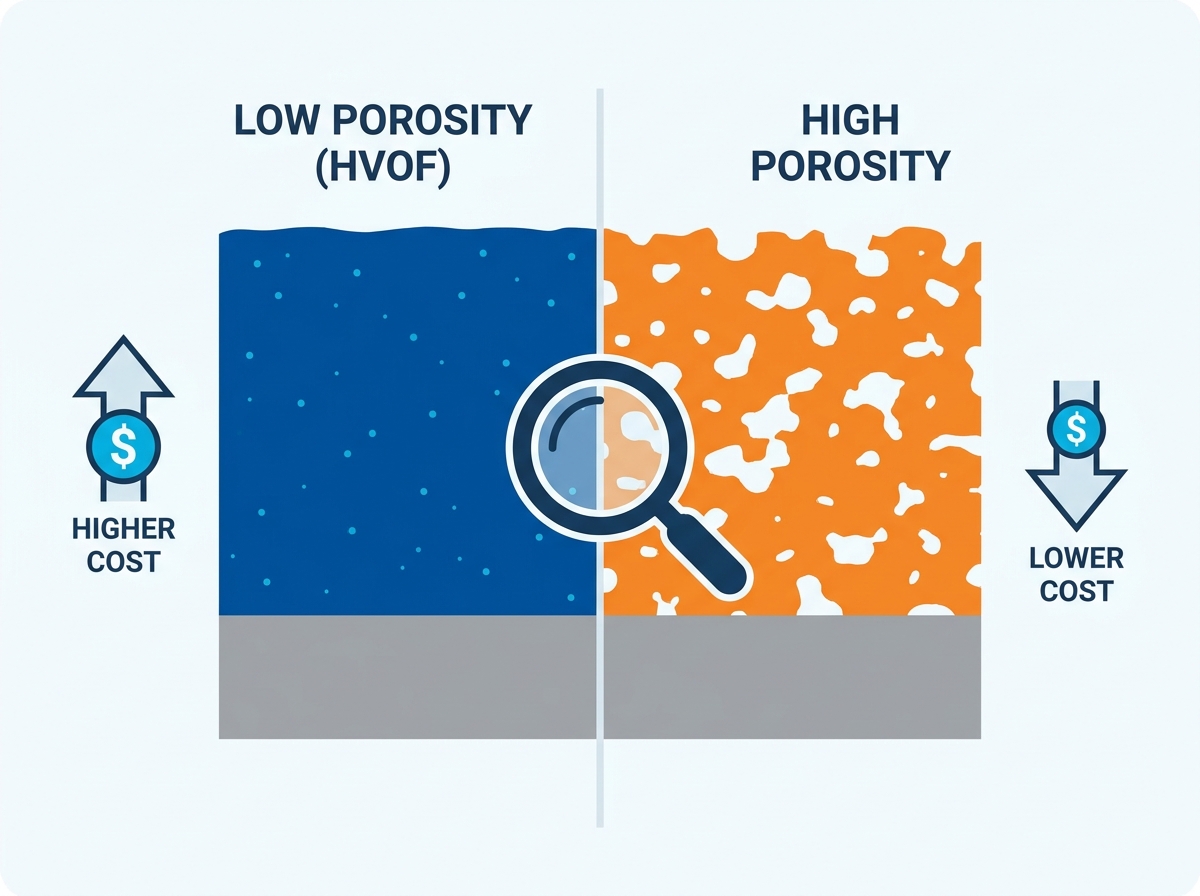
Porosity serves as the primary quality metric separating basic industrial coatings from premium surface engineering solutions. Evaluating porosity provides a direct link between technical features and operational outcomes. Lower porosity directly correlates with increased equipment complexity and higher consumable usage.
Porosity refers to the microscopic voids present within the applied coating structure. Some degree of porosity exists in almost all thermal spray applications. Interconnected porosity presents a severe threat in corrosive or high-wear environments. Voids that connect from the coating surface down to the base material create pathways for corrosive agents.
When corrosive fluids penetrate these interconnected pathways, they attack the substrate directly. This leads to rapid delamination and catastrophic component failure. Eliminating interconnected voids is mandatory for parts operating in subsea, chemical processing, or severe abrasive environments. A dense coating acts as an absolute barrier, sealing the vulnerable base metal away from the harsh operating environment.
Achieving porosity levels below one percent requires High-Velocity Oxygen Fuel (HVOF) technology. HVOF systems utilize a high-pressure combustion process. Oxygen mixes with a fuel gas or liquid kerosene to create a supersonic exhaust jet. Powder injects into this jet, accelerating to extreme velocities before impacting the substrate.
The kinetic energy generated by this process flattens the particles upon impact, creating an incredibly dense, tightly packed structure. Minimizing HVOF coating porosity demands specific operational inputs. The process consumes high volumes of combustion gases. It requires specialized, high-capacity cooling systems to manage torch temperatures. Operators must use premium, tightly sized carbide powders to ensure consistent heating and acceleration.
Specifying strict porosity limits requires a higher upfront investment. Buyers must weigh this initial requirement against long-term operational realities. Utilizing a highly porous method like flame spray reduces immediate expenditure. However, deploying a porous coating in a severe environment guarantees premature part replacement.
The operational downtime and replacement logistics quickly eclipse the savings gained from choosing a basic coating method. Investing in high-velocity processes ensures the component survives its intended lifecycle. The density achieved through kinetic energy provides superior wear resistance and absolute barrier protection against chemical attack.
Thermal spray encompasses multiple distinct technologies. Each method occupies a specific tier based on the protection required. Matching the application method to the specific environmental threat prevents over-engineering and optimizes the investment.
Application Method | Primary Energy Source | Typical Porosity Level | Best Suited For |
|---|---|---|---|
Flame Spray | Oxy-Fuel Combustion | High (10% - 15%) | Dimensional restoration, basic corrosion |
Wire Arc | Electrical Arc | Medium-High (5% - 10%) | Large infrastructure, atmospheric protection |
Air Plasma Spray (APS) | Plasma Plume | Medium (2% - 7%) | Thermal barrier coatings, ceramics |
HVOF / HVAF | Supersonic Combustion | Very Low (< 1%) | Extreme wear, severe chemical corrosion |
Flame spray and wire arc represent the most accessible thermal spray technologies. These methods excel at basic dimensional restoration. They provide excellent atmospheric corrosion protection for bridges, structural steel, and large infrastructure projects. The equipment is portable and highly efficient at depositing large volumes of material.
The trade-off involves coating density and mechanical bonding. These processes rely primarily on thermal energy rather than kinetic energy. The resulting coatings exhibit lower bond strengths and higher porosity levels. They are unsuitable for severe abrasive wear or high-pressure chemical environments.
Air Plasma Spray utilizes an electrical arc to ionize inert gases, creating a high-temperature plasma plume. This plume reaches temperatures capable of melting virtually any material, including high-melting-point ceramics. APS is the standard method for applying thermal barrier coatings (TBCs) in aerospace and power generation applications.
The economics of APS reflect the specialized nature of the process. Generating the plasma requires massive electrical input. The process consumes expensive plasma gases like argon and helium. The resulting ceramic coatings provide exceptional heat resistance but retain a controlled degree of porosity to accommodate thermal expansion during rapid heating and cooling cycles.
High-Velocity Oxygen Fuel (HVOF) and High-Velocity Air Fuel (HVAF) sit at the premium tier of surface engineering. These processes prioritize kinetic energy over thermal energy. The extreme particle velocities maximize coating density and bond strength. They are the definitive choice for applying tungsten carbide and chrome carbide.
These technologies provide unparalleled resistance to abrasive wear, erosion, and chemical corrosion. The operational hourly rates reflect the massive gas consumption and premium powder requirements. The investment is justified by the resulting surface integrity, which routinely outperforms solid hardened alloys in severe industrial applications.
Evaluating surface engineering requires shifting focus from the immediate coating application to long-term strategic savings. The true value emerges when analyzing the complete lifecycle of an industrial component. Smart engineering strategies leverage targeted coatings to replace expensive solid materials.
Manufacturing entire components from solid superalloys presents massive material and machining challenges. Materials like Inconel, Hastelloy, and solid titanium are difficult to source and notoriously hard to machine. Tooling wear is rapid, and machining times are extensive. This drives the baseline manufacturing investment incredibly high.
A more efficient framework involves machining the component from an accessible, easy-to-machine base material like 4140 carbon steel. Engineers then apply an HVOF tungsten carbide coating strictly to the critical wear surfaces. This strategy drastically reduces raw material expenditure and machining time while delivering superior surface performance exactly where it is needed.
The long-term return on investment relies on extending the Mean Time Between Failures (MTBF). Minimizing HVOF coating porosity ensures the component resists environmental degradation for extended periods. Parts stay in service longer, directly reducing maintenance intervals and preventing unexpected operational shutdowns.
When a coated part eventually wears down, it does not need to be discarded. Engineers can strip the remaining coating and re-apply a new thermal spray layer. This localized refurbishment restores the component to original OEM specifications. The ability to re-coat existing parts eliminates the need to manufacture entirely new replacement components, compounding the lifecycle savings.
Deciding whether to integrate thermal spray capabilities internally or utilize a service provider requires careful operational analysis. Both models present distinct implementation challenges. Decision-makers must evaluate their production volume and internal metallurgical expertise.
Purchasing a thermal spray system requires a significant capital investment. A complete HVOF, HVAF, or APS setup involves much more than just a spray torch. The system requires sophisticated mass flow controllers, heavy-duty powder feeders, and industrial water chillers. The core equipment represents only a portion of the required infrastructure.
Facility requirements demand massive modifications. Thermal spray generates extreme noise levels, requiring custom-built acoustical enclosures. Precision application necessitates six-axis robotic manipulation and programmable turntables. Safe operation mandates high-capacity dust collection and specialized ventilation systems to handle hazardous metallic dust.
Operating a spray cell introduces continuous operational expenditures. Consumable gases deplete rapidly during production runs. Gun hardware, including precision nozzles and electrodes, wears out constantly and requires frequent replacement. The high-velocity combustion process is inherently destructive to the equipment itself.
Retaining skilled personnel presents another major operational hurdle. Thermal spray is not a standard manufacturing process. It requires dedicated metallurgists to develop spray parameters and highly trained operators to execute the process safely. The internal labor burden is substantial and requires continuous training.
Outsourcing remains the most viable financial route for low-to-medium volume production. Service providers absorb the massive capital and operational burdens. They structure their pricing based on specific project requirements rather than continuous overhead.
Quotes from toll coaters typically include initial setup fees, hourly booth rates, material markups, and inspection charges. Volume discounts apply when processing large batches of identical parts. Outsourcing grants immediate access to premium technologies and experienced metallurgical teams without the facility modifications.
Procurement teams often encounter hidden variables that disrupt initial projections. Understanding the complete manufacturing sequence prevents unexpected cost overruns. The spray process represents only one phase of component realization.
Thermal spray coatings rarely leave the spray booth at final dimensional tolerances. The surface finish is typically rough, often resembling heavy sandpaper, and requires secondary processing. Hard industrial coatings, especially low-porosity carbides, cannot be machined using traditional turning or milling techniques. Standard carbide inserts will shatter or wear instantly against a tungsten carbide surface.
Achieving final dimensions requires specialized diamond grinding. Operators must use resin-bonded or metal-bonded diamond wheels to slowly remove excess coating material. This grinding process is slow, precise, and highly specialized. The machine must flood the work area with synthetic coolant to prevent heat checking—microscopic surface cracks caused by localized thermal expansion during grinding. Post-coating finishing often requires more time, specialized machinery, and labor resources than the actual thermal spray application.
Verifying coating quality introduces necessary compliance requirements. Visual inspection is insufficient for severe industrial applications. Engineers require quantitative proof that the coating meets strict density and bond strength specifications. This validation requires destructive testing on representative sample coupons sprayed simultaneously with the actual components.
Laboratories perform ASTM C633 tensile tests to verify mechanical bond strength. This involves bonding the coated coupon to an uncoated mating cylinder using high-strength structural epoxy, then pulling them apart in a tensile testing machine to measure the exact failure point. Furthermore, metallurgists mount, polish, and examine cross-sections under high-magnification microscopes. The samples undergo vacuum epoxy impregnation to prevent coating pull-out during the polishing phase, which an untrained eye might misidentify as porosity. This rigorous metallographic evaluation is the only way to definitively verify porosity limits and ensure the coating structure is sound.
Buyers must demand transparency during the quoting phase. Vague quotes lead to implementation risks. Require detailed, spec-driven proposals from service providers. The quote must explicitly separate the distinct phases of production.
Ensure the documentation isolates surface preparation, complex masking, raw material consumption, spray booth time, diamond grinding, and laboratory inspection. Itemized quotes allow procurement teams to accurately compare service providers and understand exactly what technical specifications are driving the final investment.
The investment required for thermal spray coating directly reflects the severity of the operating environment. Surface engineering is not a commodity purchase; it is a strategic decision to enhance component lifespan. Achieving specific engineering tolerances dictates the necessary equipment, materials, and labor.
Buyers must match the application method to their exact wear, heat, or corrosion requirements. Basic dimensional restoration aligns well with economical arc spray methods. Premium processes like HVOF must be reserved for applications where minimal porosity and maximum bond strength are absolute operational necessities.
Define exact operational parameters, including peak temperatures, abrasive media exposure, and substrate material properties.
Evaluate the feasibility of substituting solid superalloys with coated carbon steel to optimize manufacturing efficiency.
Request fully itemized quotes from certified thermal spray providers that separate masking, spraying, grinding, and inspection phases.
Specify required porosity limits and bond strength metrics in the initial request for quotation to ensure accurate technical proposals.
A: Purchasing a system requires significant capital for the core technology, including mass flow controllers, torches, and chillers. Facility modifications demand equal investment, requiring soundproof acoustical enclosures, six-axis robotics, and heavy-duty dust collection systems to manage hazardous metallic dust safely. Exact investments vary based on specific operational requirements.
A: Achieving porosity levels below one percent requires sophisticated high-velocity equipment. The process consumes massive volumes of industrial gases and requires premium, tightly sized carbide powders. This drives up the hourly operational rate but drastically improves the component's lifespan in severe environments by preventing corrosive media from reaching the substrate.
A: Thermal spray is rapidly replacing hard chrome due to stringent environmental compliance regulations surrounding hexavalent chromium. While initial application investments vary, thermal spray offers a vastly superior performance lifecycle, faster deposition rates, and eliminates the toxic waste disposal burdens associated with traditional chemical plating processes.
A: Providers utilize a comprehensive formula. They calculate custom masking and surface preparation labor, raw material consumption, hourly spray booth time, specialized diamond grinding for final dimensions, and laboratory testing for quality control verification. Each phase requires distinct labor and consumable inputs that shape the final proposal.
A: Softer materials like aluminum or zinc can be turned using standard machining techniques. However, hard industrial coatings, particularly carbides and ceramics applied via high-velocity or plasma systems, require specialized diamond grinding to achieve final dimensional tolerances and precise surface finishes. Standard carbide inserts will shatter against these surfaces.
A: Wire arc and flame spray represent the most accessible technologies. They are highly efficient for basic dimensional restoration and atmospheric corrosion protection on large infrastructure. They are ideal when high bond strength is not critical and higher porosity is acceptable for the intended operational environment.